 developer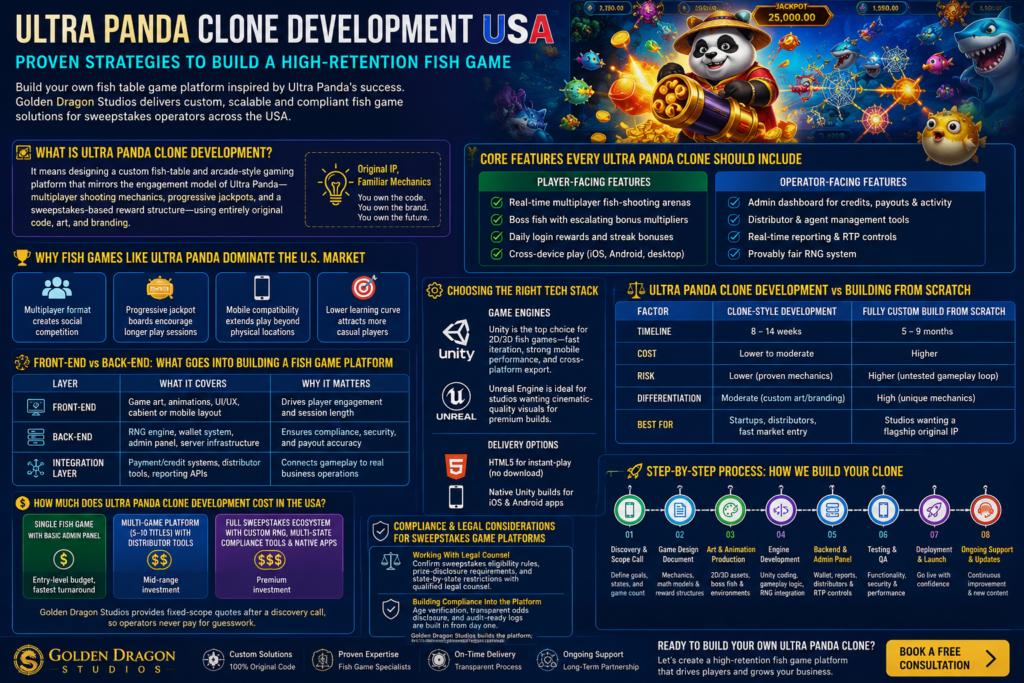
Fish table games have quietly become one of the most profitable niches in the American sweepstakes and arcade-gaming market. Operators from Texas to North Carolina are searching for a reliable partner to replicate the success of platforms like Ultra Panda — without the guesswork.
That’s where Ultra Panda clone development comes in. It’s not about copying code line by line. It’s about studying what makes a fish-shooter platform addictive, compliant, and scalable, then rebuilding those mechanics as an original product you fully own.
This guide breaks down exactly how that process works, what it costs, which mistakes to avoid, and how Golden Dragon Studios approaches every build from the ground up.
What Is Ultra Panda Clone Development?
Ultra Panda clone development means designing a custom fish-table and arcade-style gaming platform that mirrors the engagement model of Ultra Panda — multiplayer shooting mechanics, progressive jackpots, and a sweepstakes-based reward structure — while using entirely original code, art, and branding.
Original IP, Familiar Mechanics
A properly built clone never reuses Ultra Panda’s trademarks, artwork, or backend. Instead, developers rebuild the genre’s proven gameplay loop — cannon-based fish hunting, boss battles, and community jackpots — under a new brand that operators fully own and control.
Why Operators Choose This Route
Building from a proven gameplay template shortens development time, reduces risk, and gives founders a launch-ready product without reinventing genre mechanics that already work with U.S. players.
Why Fish Games Like Ultra Panda Dominate the U.S. Sweepstakes Market
Fish table games sit at the intersection of skill and chance, which keeps regulatory friction lower than traditional slots in many jurisdictions while still delivering casino-style excitement.
- Multiplayer format creates social competition inside game rooms and cafés
- Progressive jackpot boards encourage longer play sessions
- Mobile compatibility lets operators extend play beyond physical locations
- Lower learning curve than table games attracts casual players
Core Features Every Ultra Panda Clone Should Include
A competitive fish game needs more than nice visuals. It needs a feature set that supports retention, fairness, and operator control.
Player-Facing Features
- Real-time multiplayer fish-shooting arenas
- Boss fish with escalating bonus multipliers
- Daily login rewards and streak bonuses
- Cross-device play (iOS, Android, desktop)
Operator-Facing Features
- Admin dashboard for credits, payouts, and player activity
- Distributor and agent management tools
- Real-time reporting and RTP (return-to-player) controls
- Provably fair random number generation (RNG)
Front-End vs Back-End: What Goes Into Building a Fish Game Platform
Understanding the two halves of development helps operators evaluate vendors more accurately.
| Layer | What It Covers | Why It Matters |
|---|---|---|
| Front-End | Game art, animations, UI/UX, cabinet or mobile layout | Drives player engagement and session length |
| Back-End | RNG engine, wallet system, admin panel, server infrastructure | Ensures compliance, security, and payout accuracy |
| Integration Layer | Payment/credit systems, distributor tools, reporting APIs | Connects gameplay to real business operations |
Choosing the Right Tech Stack for Your Ultra Panda Clone
The technology behind a fish game determines its performance, scalability, and cross-platform reach.
Game Engines
Unity remains the top choice for 2D/3D fish games because it supports fast iteration, strong mobile performance, and cross-platform export. Unreal Engine is better suited to studios wanting cinematic-quality visuals for premium builds.
Web and Mobile Delivery
HTML5 is commonly used for instant-play, no-download versions that run in a browser, while native Unity builds power the downloadable mobile apps distributors typically require.
Ultra Panda Clone Development vs Building From Scratch
| Factor | Clone-Style Development | Fully Custom Build From Scratch |
|---|---|---|
| Timeline | 8–14 weeks | 5–9 months |
| Cost | Lower to moderate | Higher |
| Risk | Lower (proven mechanics) | Higher (untested gameplay loop) |
| Differentiation | Moderate (custom art/branding) | High (unique mechanics) |
| Best For | Startups, distributors, fast market entry | Studios wanting a flagship original IP |
How Much Does Ultra Panda Clone Development Cost in the USA?
Pricing depends on platform scope, number of games, and backend complexity. As a general guide:
- Single fish game with basic admin panel: Entry-level budget, fastest turnaround
- Multi-game platform (5–10 titles) with distributor tools: Mid-range investment
- Full sweepstakes ecosystem with custom RNG, multi-state compliance tools, and native apps: Premium investment
Golden Dragon Studios provides fixed-scope quotes after a discovery call, so operators never pay for guesswork.
Compliance & Legal Considerations for Sweepstakes Game Platforms
Sweepstakes gaming operates under promotional prize-law frameworks rather than traditional gambling regulation, which varies by state.
Working With Legal Counsel
Before launch, operators should confirm sweepstakes eligibility rules, prize-disclosure requirements, and state-by-state restrictions with qualified legal counsel — Golden Dragon Studios builds the platform; it does not provide legal advice.
Building Compliance Into the Platform
Good development partners bake in age verification, transparent odds disclosure, and audit-ready transaction logs from day one, rather than retrofitting them after launch.
Step-by-Step Process: How Golden Dragon Studios Builds Your Clone
- Discovery & Scope Call — define target states, game count, and platform goals
- Game Design Document — mechanics, math models, and reward structures
- Art & Animation Production — 2D/3D assets, boss fish, environments
- Engine Development — Unity or HTML5 build with RNG and wallet integration
- QA & Compliance Testing — payout accuracy, load testing, fairness audits
- Launch & Distributor Onboarding — deployment plus training for agents
- Post-Launch Support — updates, new game additions, bug fixes
Retention Strategies That Keep Fish Game Players Coming Back
Reward Loops
Daily bonuses, streak multipliers, and surprise jackpot triggers keep session frequency high without relying purely on volatility.
Social Competition
Leaderboards and community jackpot boards tap into competitive instincts, which is one reason multiplayer fish games outperform single-player slots in average session length.
Fresh Content Cadence
Rotating boss fish events and seasonal skins give returning players a reason to log in beyond the base gameplay loop.
Common Mistakes to Avoid When Hiring Ultra Panda Clone Game Developers USA
- Skipping a discovery phase — leads to scope creep and budget overruns
- Ignoring RNG certification — creates compliance exposure at launch
- Choosing the cheapest bid — often means outdated tech stacks and no post-launch support
- Underestimating art production time — fish games live or die on visual polish
- No distributor training plan — even a great platform fails without operator onboarding
Why Choose Golden Dragon Studios as Your Ultra Panda Clone Game Development Company
Golden Dragon Studios combines full-cycle game development — from concept art to Unity engineering to post-launch support — with direct experience in casino, sweepstakes, and fish-game mechanics built specifically for U.S. operators, distributors, and startup founders.
Expert Tips From Our Development Team
- Start with one flagship fish game, then expand the library once it proves engagement
- Request a demo build before committing to full-scope development
- Ask any Ultra Panda clone game development company for references from active U.S. distributors
Frequently Asked Questions
1. What is Ultra Panda clone development?
It’s the process of building an original fish-table gaming platform inspired by Ultra Panda’s engagement mechanics, using new code, art, and branding fully owned by the operator.
2. Is it legal to build a game similar to Ultra Panda?
Yes, as long as the new platform uses original assets and code and complies with applicable state sweepstakes and promotional gaming laws.
3. How long does it take to build a fish game clone?
Most single-game builds take 8–14 weeks, depending on feature complexity and platform scope.
4. What engine is best for fish game development? Unity is the industry standard for cross-platform fish games; HTML5 works well for instant-play browser versions.
5. Do I need a license to distribute a fish game platform?
Requirements vary by state. Operators should confirm sweepstakes and prize-promotion compliance with legal counsel before launch.
6. Can Golden Dragon Studios add new games after launch?
Yes. Ongoing game maintenance and support includes adding new titles, updating art, and expanding features over time.
7. What makes a fish game “high retention”?
A mix of multiplayer competition, progressive jackpots, daily rewards, and fresh content cycles that give players a reason to return regularly.
8. How much does an Ultra Panda-style platform cost?
Costs scale with scope — from a single game with basic admin tools to a full multi-game ecosystem with distributor management.
9. Do you provide the RNG and payout system?
Yes, Golden Dragon Studios builds provably fair RNG engines along with wallet and payout infrastructure as part of full-cycle development.
10. Can the platform work on both mobile and desktop?
Yes, cross-platform compatibility across iOS, Android, and desktop browsers is built into every clone project.
Conclusion
Ultra Panda’s success proves that U.S. players respond strongly to multiplayer fish games built around skill, competition, and consistent rewards. Ultra Panda clone development gives operators a faster, lower-risk path to launching that same experience under their own brand — as long as it’s built by a team that understands both the gameplay mechanics and the compliance landscape around it.
Golden Dragon Studios brings full-cycle expertise to every build: game design, Unity and HTML5 engineering, 2D/3D art, and long-term support after launch.