 developer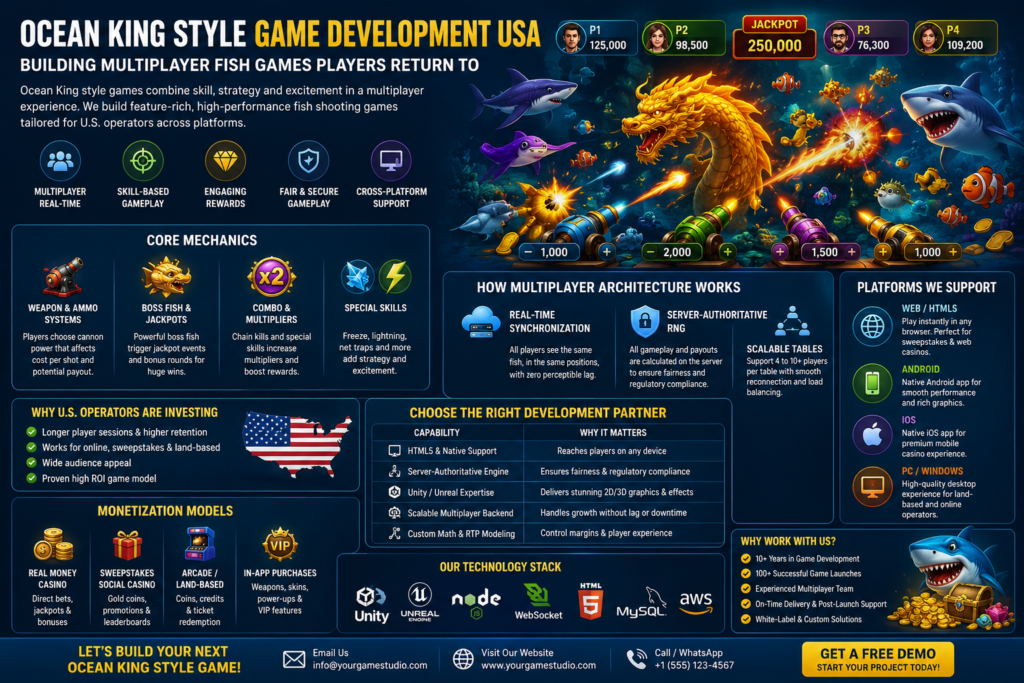
Introduction
Fish shooting games didn’t stay a Southeast Asian arcade trend. They became one of the most reliable revenue engines in American social and real-money gaming rooms. Ocean King proved that a shared table, big schools of fish, and a shooting mechanic could hold a player’s attention longer than most slot titles.
Operators across the USA now want that same formula, but tailored to their brand, their compliance needs, and their player base. That’s where Ocean King style game development USA comes in — not copying an existing title, but engineering a new multiplayer fish game built on proven mechanics.
This guide breaks down how these games work, what makes players stick around, and what to look for when hiring a studio to build one.
What Is Ocean King Style Game Development?
The Origins of the Fish Game Genre
Ocean King launched in Chinese arcades over a decade ago and spread through Asian gaming halls before reaching U.S. casino floors and online sweepstakes platforms. Players buy in with credits, aim a cannon at swimming fish and bosses, and win payouts based on the creature’s point value.
Why It Translated So Well to Digital and Online Platforms
The genre works because it blends skill-based aiming with chance-based rewards. That hybrid appeals to players who find pure slot spinning repetitive. Moving the format online opened it up to mobile casinos, sweepstakes operators, and social gaming apps across the United States.
Why U.S. Operators Are Investing in Fish Game Development
Multiplayer Formats Increase Session Length
A shared table means players see other people winning in real time. That social pressure and excitement keep sessions running longer than solo slot play, which directly improves average revenue per user.
Fish Games Fit Multiple Licensing Models
- Real-money online casinos
- Sweepstakes and social casino platforms
- Land-based arcade and route operators
- Tribal and commercial casino floors
This flexibility is a major reason Ocean King style game developers USA are seeing steady demand from operators diversifying beyond traditional slots.
Core Mechanics That Make a Fish Game Actually Fun
Weapon and Ammo Systems
Players choose cannon strength, which affects both cost per shot and potential payout. Balancing this economy is one of the harder design problems in the genre — too generous and margins collapse, too tight and players disengage.
Boss Fish and Jackpot Events
Large “boss” creatures that require sustained fire and often trigger bonus rounds or progressive jackpots. These moments are what players talk about after a session, and they’re a major retention lever.
Combo and Multiplier Triggers
Chaining kills, hitting multiple fish with one shot, or triggering elemental effects (freeze, lightning, net traps) add skill expression on top of the base RNG.
How Multiplayer Architecture Works Behind the Scenes
Real-Time Synchronization
Every player at the table needs to see the same fish, in the same positions, moving in sync, with zero perceptible lag. This requires a dedicated real-time server architecture, not a simple client-side loop.
Server-Authoritative RNG for Fairness
To satisfy regulators and build player trust, the random number generation and payout logic must run server-side, with the client only rendering results. This is non-negotiable for any studio offering real Ocean King-style game development.
Table Scaling and Load Balancing
Popular tables can hold anywhere from 4 to 10+ concurrent players. The backend needs to handle table creation, matchmaking, and disconnection/reconnection gracefully without breaking game state for everyone else at the table.
Choosing the Right Ocean King Style Game Development Company
Technical Capabilities to Look For
| Capability | Why It Matters |
|---|---|
| HTML5 and native mobile support | Reaches players on any device without app-store friction |
| Server-authoritative game engine | Required for regulatory compliance and fairness |
| Unity or Unreal Engine expertise | Enables richer 3D fish, effects, and animations |
| Scalable multiplayer backend | Supports growth without table lag or downtime |
| Custom math and RTP modeling | Lets operators control margin and payout behavior |
Questions to Ask Before Signing a Contract
- Can you show a working multiplayer demo, not just static screenshots?
- How do you handle RNG certification and jurisdiction-specific compliance?
- What’s your post-launch support and bug-fix turnaround?
- Do you offer white-label or fully custom builds?
- Can the game integrate with our existing platform or wallet system?
HTML5 vs Native Mobile Development for Fish Games
When HTML5 Makes Sense
HTML5 fish games run instantly in a browser, which is ideal for sweepstakes cafes and web-based casino portals where install friction kills conversion.
When Native Development Is Worth It
Native builds using Unity or Unreal Engine deliver smoother particle effects, richer boss animations, and better performance for heavier 3D visual styles. Operators targeting app-store distribution usually need this route.
| Factor | HTML5 | Native (Unity/Unreal) |
|---|---|---|
| Load time | Instant, no install | Requires download |
| Visual fidelity | Good | Excellent |
| Distribution | Any browser/device | App stores, direct install |
| Best for | Web/sweepstakes platforms | Branded mobile casino apps |
Game Art and Animation: What Separates Average Fish Games From Great Ones
Character and Environment Design
Fish variety, boss creature design, and underwater environment art directly affect how “premium” a game feels. Generic sprite-based fish read as dated within months of launch.
Animation and Visual Feedback
Satisfying hit effects, water ripples, and death animations reinforce the reward loop. Players notice when a kill “feels” weak, even if they can’t articulate why they lost interest.
Monetization Models for Ocean King Style Games
Credit-Based Buy-In Systems
Players purchase in-game currency to fire weapons, common in sweepstakes and social casino formats operating in a legal gray area of real-money play.
Real-Money Wagering Integration
For licensed real-money platforms, the game connects directly to a regulated wallet and payment processor, with full audit trails for every transaction.
Progressive Jackpot Networks
Linking multiple tables or venues into a shared jackpot pool increases excitement and can be a strong differentiator for operators competing on player acquisition.
Expert Tips for a Successful Fish Game Launch
- Playtest with real players before launch, not just internal QA — table dynamics change with real behavior
- Start with 2–3 boss fish tiers rather than overcomplicating the payout table at launch.
- Build analytics into the game from day one to track session length and average bet
- Plan for regular content updates; stale fish rosters lose players within a few months.hs
- Keep the ammo economy transparent so players understand cost versus reward.
Common Mistakes Operators Make
- Underestimating the backend complexity of real-time multiplayer sync
- Choosing a developer based on price alone instead of compliance track record
- Launching without jurisdiction-specific RNG certification
- Ignoring mobile optimization until after launch
- Copying an existing title too closely, risking IP and branding issues
Full-Cycle Development vs. Piecemeal Outsourcing
What Full-Cycle Development Includes
A true full-cycle partner handles concept, math modeling, art, development, QA, deployment, and ongoing maintenance under one roof, which reduces handoff errors between teams.
Why Piecemeal Outsourcing Often Backfires
Splitting art, backend, and compliance across separate freelancers can create integration issues that surface only after launch, when they’re far more expensive to fix.
Post-Launch Support and Long-Term Game Maintenance
Why Ongoing Support Matters More Than Launch Day
A fish game’s revenue curve depends on continuous updates — new bosses, seasonal events, and balance tweaks. Studios that disappear after launch leave operators stuck with a decaying product.
What Good Maintenance Looks Like
- Scheduled content refreshes (new fish, skins, events)
- Server monitoring and uptime guarantees
- Rapid patching for exploits or payout bugs
- Data-driven tuning based on player behavior analytics.
FAQs
1. What is Ocean King style game development? It’s the process of building a new multiplayer fish shooting game using the same core mechanics popularized by Ocean King, without copying its branding or code.
2. Is it legal to build a fish game similar to Ocean King in the USA?
Yes, as long as the game is an original build with its own art, code, and math model rather than a direct copy of protected IP.
3. How long does it take to develop a custom fish game?
A typical custom build ranges from 4 to 9 months depending on scope, platform, and whether real-money compliance is required.
4. What platforms can Ocean King style games run on?
They can be built for web (HTML5), iOS, Android, and dedicated arcade cabinets, depending on the operator’s distribution channel.
5. How much does Ocean King style game development cost?
Costs vary widely based on features, art fidelity, and multiplayer complexity, typically ranging from tens of thousands to several hundred thousand dollars for a fully custom build.
6. Do these games use real random number generators?
Yes, reputable developers use server-authoritative, certified RNG systems to ensure fair and regulator-compliant outcomes.
7. Can fish games be customized with our own branding?
Absolutely — art style, fish characters, sound design, and UI can all be built around an operator’s existing brand identity.
8. What engines are best for fish game development?
Unity is common for cross-platform mobile builds, while Unreal Engine suits studios wanting higher-end 3D visual fidelity.
9. How do multiplayer fish games handle fairness across players?
Server-side game logic ensures every player sees the same synchronized fish movement and payout calculations, preventing manipulation on the client side.
10. What’s the difference between a fish game and a slot game?
Fish games combine aiming skill with chance-based rewards in a shared multiplayer table, while slots are purely chance-based and typically single-player.
Conclusion
Ocean King style fish games succeed because they combine social energy, skill-based aiming, and unpredictable jackpot moments in one shared table experience. Building one that actually retains players takes more than reskinning an existing template — it takes real-time multiplayer architecture, certified fairness systems, and art that feels premium from the first shot fired.
Golden Dragon Studios specializes in full-cycle Ocean King style game development for U.S. operators who want a game built around their brand, their compliance requirements, and their player base — not a generic clone.
Ready to build a fish game players actually stick around for? Contact Golden Dragon Studios today to discuss your project and get a custom development roadmap.