 developer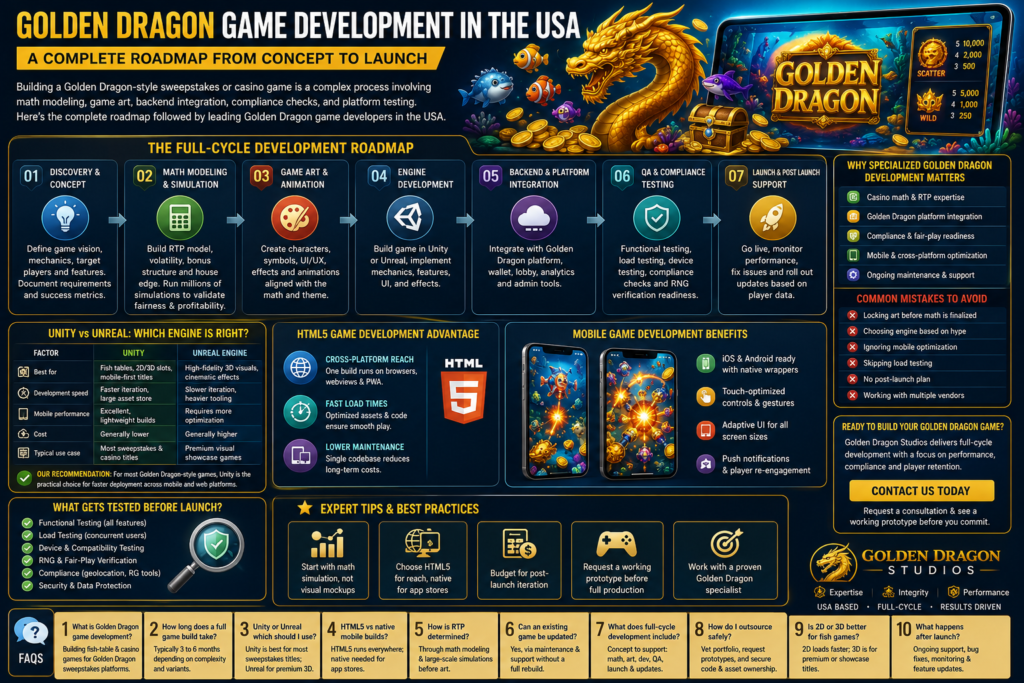
Introduction
Building a Golden Dragon-style sweepstakes or casino game isn’t a weekend project. It’s a multi-month production pipeline involving math modeling, game art, backend integration, compliance checks, and platform testing. Operators who skip steps end up with buggy launches, RTP disputes, or games that players abandon in a week.
This guide walks through the entire development roadmap that reputable Golden Dragon game developers in the USA follow, stage by stage. Whether you’re a casino operator exploring your first title or a startup founder planning a full game library, you’ll leave with a clear picture of what a professional build actually looks like — and what separates a rushed vendor from a genuine Golden Dragon game development company.
What Is Golden Dragon Game Development?
Golden Dragon game development refers to building fish-table and slot-style games compatible with the Golden Dragon sweepstakes platform ecosystem, including math models, animations, and backend hooks that mirror the format popular in US sweepstakes and social casino markets.
Why This Niche Requires Specialized Skills
Generic mobile game studios often underestimate this category. Casino math, RNG certification readiness, and real-money-adjacent compliance are not skills every game studio owns.
How Does the Development Process Actually Start?
Every serious build begins with discovery, not design software.
Defining Game Mechanics and Player Psychology
The team maps out win frequency, volatility curves, and bonus triggers before a single asset is drawn. This determines whether players stay engaged past their first session.
Setting Technical Requirements Early
Platform target (mobile, web, or hybrid), engine choice, and server architecture get locked in during this phase to avoid costly rework later.
Which Game Engine Should You Choose: Unity or Unreal?
This is one of the most common questions operators ask before hiring a Golden Dragon game development company.
| Factor | Unity Game Development | Unreal Engine Development |
|---|---|---|
| Best for | Fish tables, 2D/3D slots, mobile-first titles | High-fidelity 3D visuals, cinematic effects |
| Development speed | Faster iteration, large asset store | Slower iteration, heavier tooling |
| Mobile performance | Excellent, lightweight builds | Requires more optimization |
| Cost | Generally lower | Generally higher |
| Typical use case | Most sweepstakes and casino titles | Premium visual showcase games |
Our Recommendation for Sweepstakes Titles
For most Golden Dragon-style games, Unity remains the practical choice due to lighter builds and faster deployment across mobile and web.
How Is the Math Model Built for Fairness and Profitability?
The math model is the financial engine of the entire game.
Balancing RTP, Volatility, and House Edge
Developers simulate millions of spins to confirm the return-to-player percentage lands within the operator’s target range before art production even begins.
Simulation Testing Before Art Production
Skipping simulation is one of the most expensive mistakes an operator can make — reworking math after art is finished can double production costs.
What Happens During Game Art and Animation?
Art is where players form their first impression, but it’s built on the math, not before it.
2D vs. 3D Visual Style Decisions
2D art suits fast-loading web games and lower-bandwidth mobile markets, while 3D suits premium slot experiences aimed at desktop and high-end mobile devices.
Character, Symbol, and UI Design
- Symbol sets tied to the game’s theme
- Win/lose animation states
- HUD and paytable UI
- Sound-synced celebration effects
How Does HTML5 Game Development Fit Into Golden Dragon Titles?
Many operators want cross-platform reach without maintaining separate codebases.
Cross-Platform Compatibility Benefits
HTML5 game development lets a single build run in browsers, embedded webviews, and progressive web apps, reducing long-term maintenance overhead.
Load Time and Performance Optimization
Asset compression, lazy-loading, and sprite atlasing keep load times low even on average mobile connections common across the USA market.
What Does Mobile Game Development Add to the Build?
Mobile remains the dominant channel for sweepstakes-style play in the USA.
iOS and Android Deployment Considerations
Native wrappers, app store compliance, and push notification hooks are configured separately from the core web build.
Touch Controls and Screen Adaptation
Buttons, spin gestures, and paytable overlays are resized and tested across phone and tablet screen ratios.
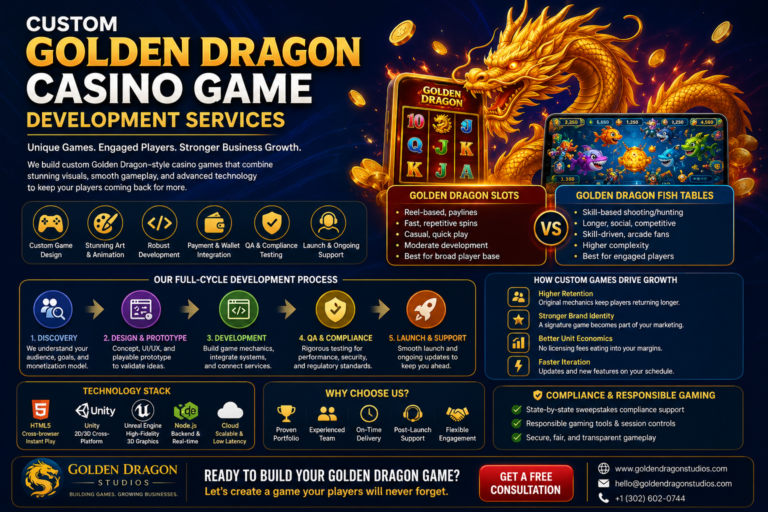
How Is Full-Cycle Game Development Structured from Start to Finish?
A true full-cycle Golden Dragon game development company manages every phase under one roof.
- Discovery and concept documentation
- Math modeling and simulation
- Art and animation production
- Engine development (Unity or Unreal)
- Backend and platform integration
- QA, compliance, and load testing
- Launch and post-launch support
Why Single-Vendor Pipelines Reduce Risk
Splitting phases across multiple freelancers or agencies creates handoff gaps — misaligned art specs, mismatched build versions, and finger-pointing when bugs appear.
What Should Be Tested Before Launch?
Skipping QA is the fastest way to damage player trust on day one.
Load Testing and Server Stability
Simulated concurrent-user traffic confirms the backend holds up during peak play windows, not just quiet hours.
Compliance and Fair-Play Verification
RNG certification readiness, geolocation checks, and responsible-gaming prompts get verified before any public rollout.
What Common Mistakes Do Operators Make in Golden Dragon Game Development?
- Locking art direction before the math model is finalized
- Choosing an engine based on hype rather than platform needs
- Underestimating mobile optimization for older devices
- Launching without adequate load testing
- Ignoring post-launch support and update planning
- Working with multiple disconnected vendors instead of one accountable team
Expert Tips and Best Practices
- Start with math simulation, not visual mockups
- Choose HTML5 for reach, native wrappers for app-store presence
- Budget for post-launch iteration, not just the initial build
- Request a working prototype before committing to full production
- Ask any Golden Dragon game developers USA vendor for prior sweepstakes-specific portfolio examples
FAQs
1. What is Golden Dragon game development?
It’s the process of building fish-table and casino-style games compatible with Golden Dragon-format sweepstakes platforms, covering math, art, engine work, and backend integration.
2. How long does a full game build typically take?
Most full-cycle builds run three to six months, depending on complexity, engine choice, and the number of game variants requested.
3. Should I choose Unity or Unreal Engine for my game?
Unity suits most sweepstakes titles due to faster builds and lighter mobile performance; Unreal fits projects prioritizing premium 3D visuals.
4. What’s the difference between HTML5 and native mobile builds?
HTML5 runs across browsers and webviews from one codebase, while native builds are platform-specific and often needed for app store distribution.
5. How is RTP determined in a new game?
RTP is set through math modeling and verified with large-scale simulations before any art or animation work begins.
6. Can an existing game be updated instead of rebuilt?
Yes — game maintenance and support services can add features, refresh art, or improve performance without a full rebuild.
7. What does full-cycle game development include? It covers concept, math, art, engine development, integration, QA, launch, and ongoing support under one team.
8. How do operators outsource game development safely?
By vetting a Golden Dragon game development company’s portfolio, requesting prototypes, and confirming clear ownership of source code and assets.
9. Is 2D or 3D better for fish-table games?
2D loads faster and suits most mobile and web fish-table titles; 3D is used selectively for premium or showcase games.
10. What happens after a game launches?
Ongoing maintenance handles bug fixes, performance monitoring, and feature updates based on player behavior data.
Conclusion
A successful Golden Dragon game isn’t the product of one clever idea — it’s the result of disciplined math modeling, deliberate engine choices, polished art, and rigorous testing, all coordinated under one accountable process. Operators who understand this roadmap ask better questions, spot weak vendors faster, and launch games that actually retain players.