 developer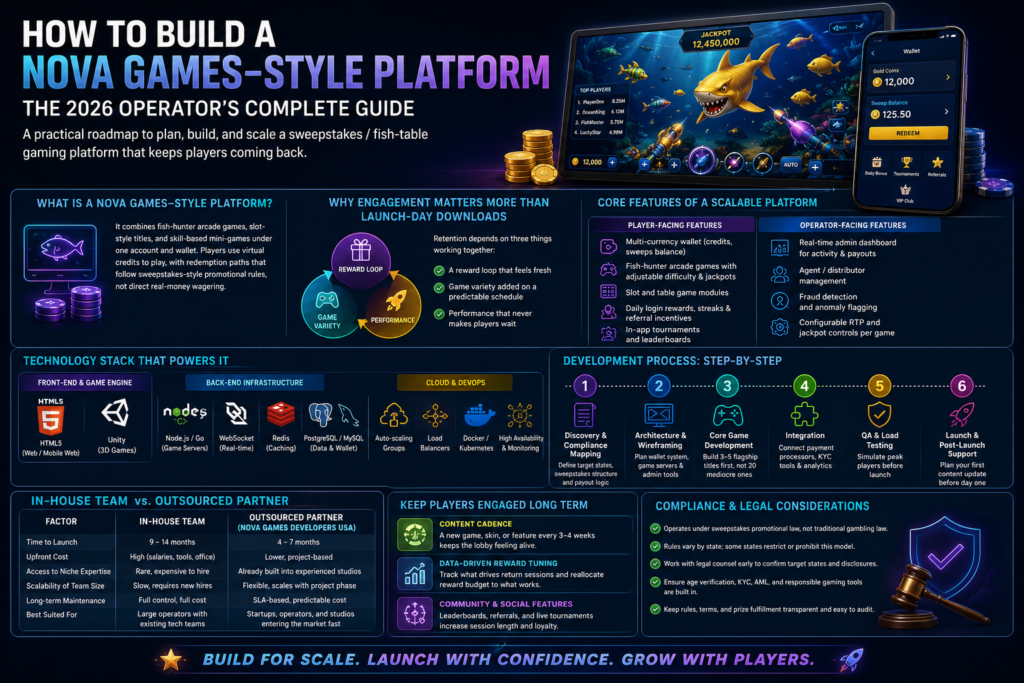
Introduction
Sweepstakes and fish-table style platforms like Nova Games have quietly become one of the fastest-growing corners of the American gaming market. Route operators, arcade owners, and online sweepstakes brands are all chasing the same formula: fast-paced multiplayer games, dual-currency rewards, and a lobby players keep coming back to.
But copying the surface look of a popular platform is easy. Building one that actually scales — without crashing during peak hours, without compliance headaches, and without losing players after week two — is a different challenge entirely.
This guide breaks down what it actually takes to plan, build, and maintain a Nova Games-style platform in 2026, written for operators, founders, and CTOs who want a real roadmap instead of marketing fluff. Whether you’re evaluating Nova Games developers USA for the first time or comparing a Nova Games clone development company against building in-house, you’ll find the practical detail you need below.
What Is a Nova Games-Style Platform, Exactly?
The Core Model
Nova Games-style platforms combine fish-hunter arcade games, slot-style titles, and skill-based mini-games under a single account and wallet system. Players use virtual credits to play, with redemption paths that follow sweepstakes-style promotional rules rather than direct real-money wagering.
Why Operators Are Drawn to This Format
The appeal is straightforward: lower regulatory friction than a full online casino license, a built-in social and competitive layer, and a game catalog that’s cheaper to expand than building a traditional slots library from scratch.
Why Does Long-Term Player Engagement Matter More Than Launch-Day Downloads?
Most new platforms get a burst of signups in the first month, then watch retention fall off a cliff. A Nova Games-style platform lives or dies on repeat sessions, not first impressions.
Retention depends on three things working together:
- A reward loop that feels fresh, not repetitive
- Game variety that’s added on a predictable schedule
- Performance that never makes players wait
Get any one of these wrong, and even a well-marketed platform will bleed players within weeks.
What Core Features Should a Scalable Nova Games Clone Include?
Player-Facing Features
- Multi-currency wallet (credits, sweeps-style redeemable balance)
- Fish-hunter arcade games with adjustable difficulty and jackpot triggers
- Slot and table game modules
- Daily login rewards, streak bonuses, and referral incentives
- In-app tournaments and leaderboards
Operator-Facing Features
- Real-time admin dashboard for player activity and payouts
- Agent/distributor management for route-based operators
- Fraud detection and anomaly flagging
- Configurable RTP and jackpot controls per game
What Technology Stack Powers a Platform Like This?
Front-End and Game Engine Choices
Most Nova Games-style titles are built with HTML5 for browser and mobile-web play, or Unity for richer 3D fish-hunter visuals and smoother animation across Android and iOS.
Back-End Infrastructure
A scalable back end typically relies on:
- Node.js or Go for real-time game servers
- WebSocket connections for live multiplayer fish-hunter rooms
- Redis for session and leaderboard caching
- PostgreSQL or MySQL for wallet and transaction integrity
Cloud and DevOps Considerations
Auto-scaling groups, load balancers, and containerized deployments (Docker/Kubernetes) matter more here than in most app categories, because player counts spike hard during evenings, weekends, and promotions.
How Should You Structure the Development Process?
- Discovery and compliance mapping — define target states, sweepstakes structure, and payout logic before writing code
- Architecture and wireframing — plan the wallet system, game server topology, and admin tools together, not separately
- Core game development — build 3–5 flagship titles first rather than 20 mediocre ones
- Integration — connect payment processors, KYC tools, and analytics
- QA and load testing — simulate peak concurrent players before launch, not after
- Launch and post-launch support — plan your first content update before day one
In-House Team vs. Outsourced Nova Games Developers USA — Which Is Better?
| Factor | In-House Team | Outsourced Development Partner |
|---|---|---|
| Time to launch | 9–14 months typical | 4–7 months typical |
| Upfront cost | High (salaries, tools, office) | Lower, project-based |
| Access to niche fish-hunter/arcade expertise | Rare, expensive to hire | Already built into experienced studios |
| Scalability of team size | Slow, requires new hires | Flexible, scales with project phase |
| Long-term maintenance | Full control, full cost | SLA-based, predictable cost |
| Best suited for | Large operators with existing tech teams | Startups, operators, and studios entering the market fast |
For most casino operators and gaming entrepreneurs, a full-cycle game development partner closes the gap between idea and live platform far faster than hiring and training an internal team from zero.
How Do You Keep Players Engaged Six Months After Launch?
Content Cadence
A new game, skin, or feature every 3–4 weeks keeps the lobby feeling alive. Stale content is the single biggest driver of churn on these platforms.
Data-Driven Reward Tuning
Track which bonuses actually drive return sessions versus which ones are claimed once and ignored, then reallocate your reward budget accordingly.
Community and Social Features
Leaderboards, referral rewards, and live tournaments turn solo play into a shared experience, which measurably increases session length.
What Compliance and Legal Factors Should Operators Plan For?
Sweepstakes-style platforms operate under promotional sweepstakes law rather than traditional gambling law, but rules vary by state, and several states restrict or prohibit this model entirely. Work with legal counsel early to confirm your target states, no-purchase-necessary structure, and redemption terms before development locks in the wallet logic.
What Does Ongoing Game Maintenance and Support Actually Involve?
- Server monitoring and uptime management
- Regular security patching and fraud pattern updates
- New game releases and seasonal content
- Bug fixes based on live player behavior data
- Compliance updates as state regulations shift
Treat this as a permanent budget line, not a one-time cost. Platforms that skip ongoing support tend to lose players to competitors within a single quarter.
Expert Tips and Best Practices
- Launch with fewer, higher-quality games rather than a bloated catalog
- Build your admin and reporting dashboard at the same time as player-facing features, not afterward
- Load-test for at least 3x your expected peak concurrent users
- Keep your reward economy simple enough to explain in one sentence
- Choose a Nova Games clone development company with proven fish-hunter and arcade game experience, not just generic slot development
Common Mistakes to Avoid
- Treating this as a simple template project — real scalability requires custom back-end architecture, not a reskinned template
- Ignoring state-by-state legal variation — a one-size-fits-all compliance approach creates risk later
- Underestimating server load — fish-hunter games are latency-sensitive; poor infrastructure planning shows up immediately during peak hours
- Launching without a content roadmap — players notice when nothing new appears after month one
- Skipping post-launch support planning — maintenance costs are often 20-30% of the original build and need to be budgeted upfront
How Long Does It Take to Build and Launch This Type of Platform?
Timelines depend on scope, but a realistic range for a full-featured platform — wallet system, 3-5 core games, admin dashboard, and compliance integration — runs between 4 and 7 months with an experienced full-cycle development partner. Adding native mobile apps, additional game titles, or multi-state compliance work typically extends this by 6-10 weeks per major addition.
FAQs
1. What is a Nova Games-style platform?
It’s a sweepstakes or arcade-style gaming platform combining fish-hunter games, slots, and reward systems under a dual-currency model, distinct from traditional real-money online casinos.
2. Is building a Nova Games clone legal in the USA?
It can be, depending on state-specific sweepstakes laws and how the platform’s no-purchase-necessary structure is designed. Legal review before development is essential.
3. How much does Nova Games game development cost?
Costs vary widely based on game count, platform complexity, and compliance scope, but most full-cycle projects range from mid-five figures to low six figures depending on features.
4. What game engine is best for this type of platform?
HTML5 works well for cross-platform browser play, while Unity is often preferred for richer 3D fish-hunter visuals and native mobile app performance.
5. How do I choose the right Nova Games developers USA?
Look for a studio with proven full-cycle experience — game design, back-end architecture, compliance awareness, and post-launch support — rather than a team that only builds front-end visuals.
6. Can an existing casino platform add Nova Games-style games?
Yes. Many operators integrate fish-hunter and arcade titles as an additional module within an existing sweepstakes or social casino platform rather than launching a separate brand.
7. What makes players stay engaged long-term?
A steady content release schedule, well-tuned reward systems, and social features like leaderboards and tournaments are the biggest long-term retention drivers.
8. Do I need a mobile app, or is web-based enough?
A mobile-optimized web platform can launch faster and cheaper, but native apps typically improve retention and notification reach once the platform proves demand.
9. How is player data and fraud handled on these platforms?
Reputable platforms use real-time anomaly detection, KYC checks at redemption points, and encrypted transaction logging to protect both players and operators.
10. What ongoing support does a platform need after launch?
Server monitoring, regular game updates, security patching, and compliance monitoring should all be budgeted as recurring costs, not one-time expenses.
Conclusion
A Nova Games-style platform can become a genuinely durable business, but only if it’s engineered for scale from day one rather than patched together to launch quickly. The operators who succeed long-term treat game variety, infrastructure, compliance, and player rewards as one connected system, not separate checkboxes.
If you’re evaluating how to move from concept to a live, scalable platform, the fastest and lowest-risk path is partnering with a team that has already solved these problems before